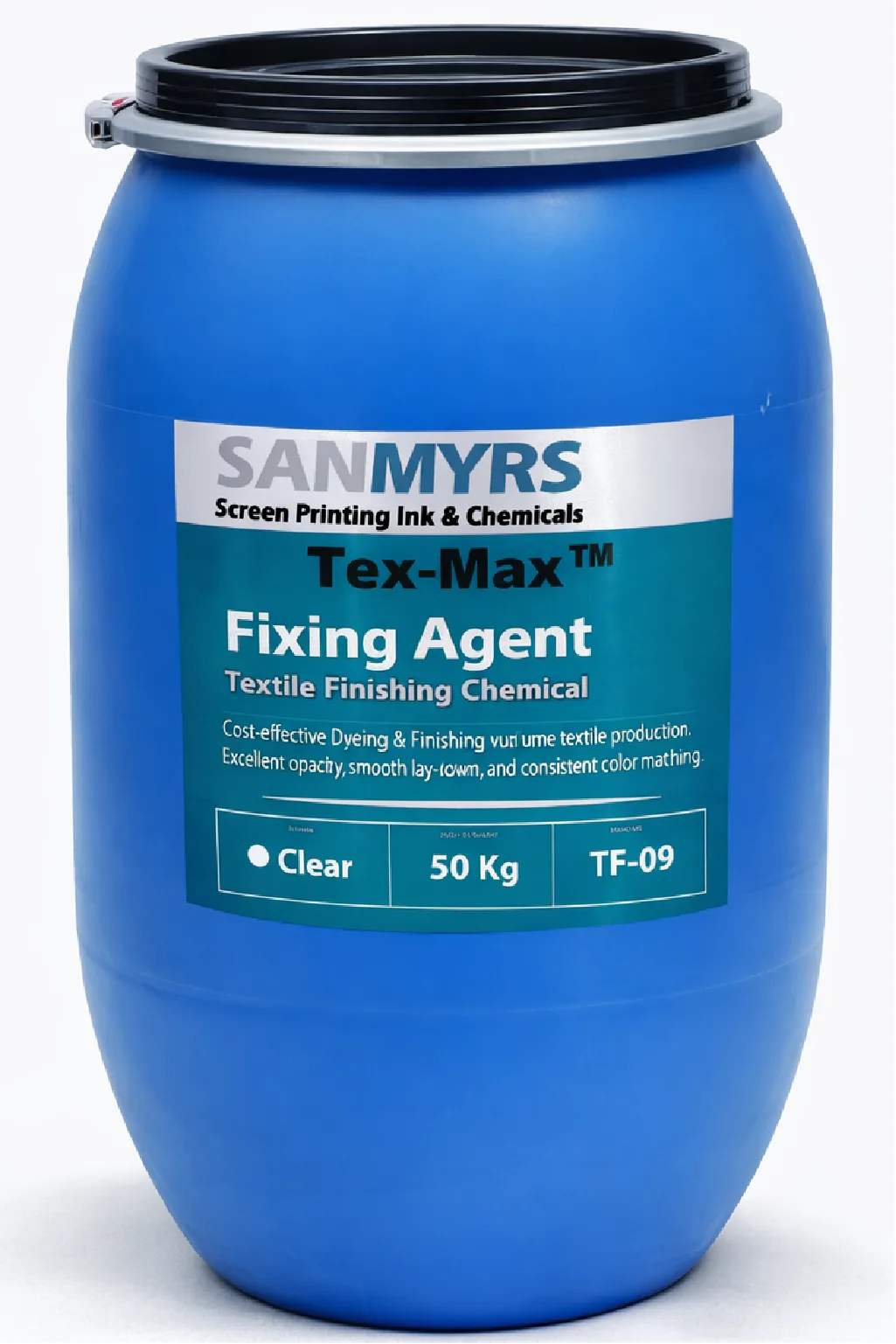
Fixing Agent
Textile fixing agents are cationic reactive polymer compounds used as aftertreatment chemistry to improve the wet fastness and crocking (rub) fastness of reactive, direct, and sulfur dyes on cellulosic fiber substrates by complexing with surface dye molecules and anchoring them to the fiber through ionic and covalent interactions. The fixing agent application stage follows dyeing and soaping in the finishing sequence, operating at 40–50°C in an exhaust or pad application to deposit the cationic polymer preferentially on anionic dye-fiber surfaces. Modern formaldehyde-free fixing agents from polyamine and polyamide-amine chemistry comply with OEKO-TEX and REACH requirements for export-oriented textile production.
Key Applications
- Wet and crock fastness improvement on reactive-dyed cotton and viscose
- Sulfur dye fastness enhancement on denim and yarn-dyed fabrics
- Export garment finishing requiring OEKO-TEX compliant dye fixation
- Wash and perspiration fastness improvement on direct-dyed cellulosics
Frequently Bought Together
Silicone Softener
Polydimethylsiloxane (PDMS) silicone softener is the most widely used textile softening technology, imparting a characteristic smooth, silky, and lubricating hand feel to synthetic and cellulosic fabrics through the formation of an oriented PDMS layer on fiber surfaces that dramatically reduces inter-fiber friction coefficients.
Textile Dyes & AuxiliariesHydrophilic Silicone Softener
Hydrophilic silicone softeners are polyether-modified polysiloxane compounds engineered to combine the soft, smooth hand-feel properties of conventional silicone with a hydrophilic molecular architecture that preserves or enhances the moisture wicking and absorbency of treated fabrics — a property that standard PDMS silicones compromise through their hydrophobic character.
Textile Dyes & AuxiliariesAmino Silicone Softener
Amino-functional silicone softeners contain reactive amine groups (primary, secondary, or tertiary amino groups) grafted onto the polysiloxane backbone, enabling the silicone to form strong electrostatic and reactive bonds with anionic fiber surfaces — particularly cotton and wool — resulting in significantly more durable softening effects and an exceptionally soft, cashmere-like tactile quality compared to unfunctionalized PDMS systems.