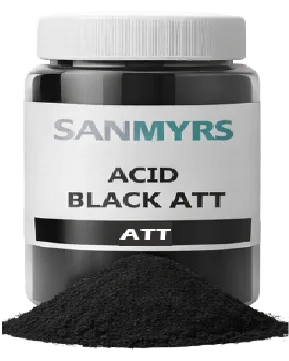
Black ATT
Acid Dyes
Acid dyes are anionic water-soluble colorants applied to protein fibers (wool, silk) and polyamide (nylon) from acidic aqueous baths, forming ionic bonds with the protonated amine groups of the fiber polymer to produce level, well-penetrated dyeings across the complete color spectrum with good to excellent wet and light fastness. The acid dye class encompasses a wide range of molecular structures including monoazo, diazo, anthraquinone, and metal-complex types with varying migration, leveling, and fastness properties suited to different fiber substrates, dyeing machinery, and end-use requirements. Metal-complex (1:2) acid dyes offer the best light and wet fastness for wool, while milling acid dyes provide excellent felting resistance for machine-washable wool programs.
Key Applications
- Exhaust dyeing of wool yarn, tops, and fabric across the full color gamut
- Piece dyeing of nylon woven and knitted fabrics
- Silk dyeing for fashion and decorative textile applications
- Dyeing of polyamide in nylon-cotton blend fabrics and hosiery
Frequently Bought Together
Direct Dyes
Direct dyes are anionic water-soluble azo and stilbene colorants that exhaust directly onto cellulosic fibers from a neutral or weakly alkaline electrolyte bath without the need for chemical fixation auxiliaries, making them among the simplest and most cost-effective dye classes for cotton, viscose, and linen in commodity shades across a full color range.
Textile Dyes & AuxiliariesIndigo Blue
Indigo Blue is the iconic vat dye responsible for the distinctive blue color of denim fabric, applied to cotton warp yarns by continuous rope or slasher dyeing using a sodium hydrosulfite reducing bath followed by air oxidation in multiple dip-nip cycles to build up the characteristic surface-dyeing that produces the ring-dyeing effect essential to authentic denim fading behavior.
Textile Dyes & AuxiliariesSulphur Dyes
Sulphur dyes are a broad class of inexpensive, water-insoluble colorants for cellulosic fibers that are applied in solubilized leuco form from an alkaline sodium sulfide reducing bath, exhaust onto cotton at moderate temperatures, and are then re-oxidized within the fiber to form their insoluble colored structure.